
- PRODUCTSFREEWAREFOR COMMERCIAL USEFOR PERSONAL AND BUSINESS USEBackup and System Restore:PC Privacy and Security:
- BUY ONLINE
- DISTRIBUTION
- Contents
- Index
- R-Drive Image
- Disk Actions
- Advanced File Filtering
- RAIDs, and Various Disk and Volume Managers
- Startup Version
- Scheduled Actions, Command Line Operations, and Scripting
-
Technical Information
- Updates
- Cloud Services
- Image Replications
- Logging
- Creating Consistent Point-in-Time Backups
- Support for Various Disk Partitioning Schemes and File Systems
- Supported Virtual Disk and Disk Image Formats
- Disk Wiping Algorithms
- Supported CD and DVD Recorders
- List of Hardware Devices Supported in the Startup Mode
- R-Drive Image OEM kit
© 2024 R-Tools Technology Inc.
All rights reserved.
Copy a Disk to a Disk
Attention: All previous data on the destination disk will be completely deleted
To copy an entire disk or its part to another one:
| 1 | Click Copy Disk on the Action Selection panel. |
R-Drive Image will start analyzing the computer disk configuration, the Progress... message showing the progress. Then the Object Selection panel will show the configuration.
 More information...
|
Disk Configuration
|
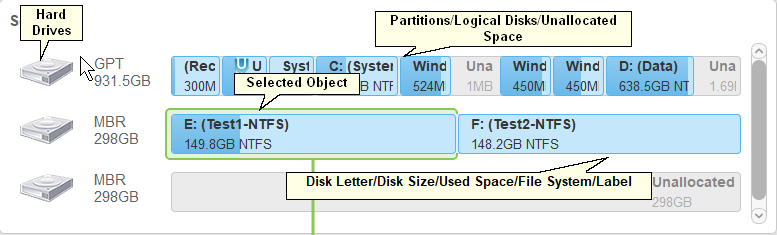
You may select all objects on a hard drive by clicking the hard drive icon .. It will show the marked hard drive .
| 2 | Select the disk object on the Source: on the Object Selection panel, select a destination, and click the Next button |
Click the controls to learn their functions or go to the respective help pages
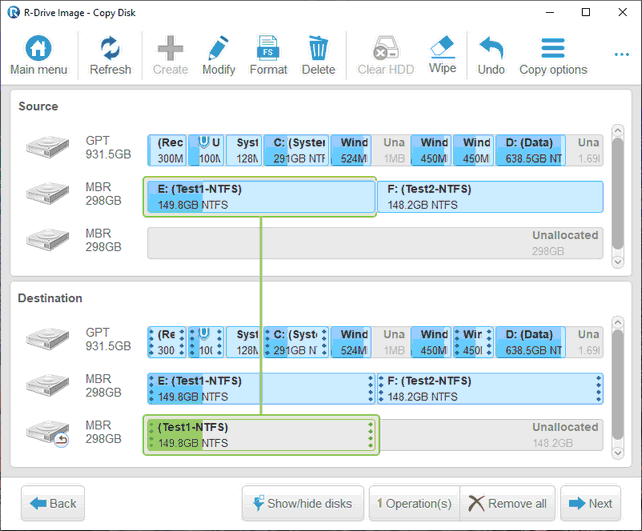
You may select only one object at a time, and you need to specify the destination to proceed further.
Use the Refresh button if your computer disk configuration has been changed (when you connect a USB disk, for example).
More information...
|
If the destination is smaller than the selected object, R-Drive Image won't allow you to select this object and you will need to select another destination. If you select several partitions as the destination, R-Drive Image will show the You have selected several partitions... message. If you click the OK button, all those partitions will be deleted and data will be restored on that free space . Note: Although R-Drive Image shows unallocated space instead of the deleted partitions, the partitions and their data will be actually deleted only when R-Drive Image starts copying the data. |
|
Selected Object and Destination
|
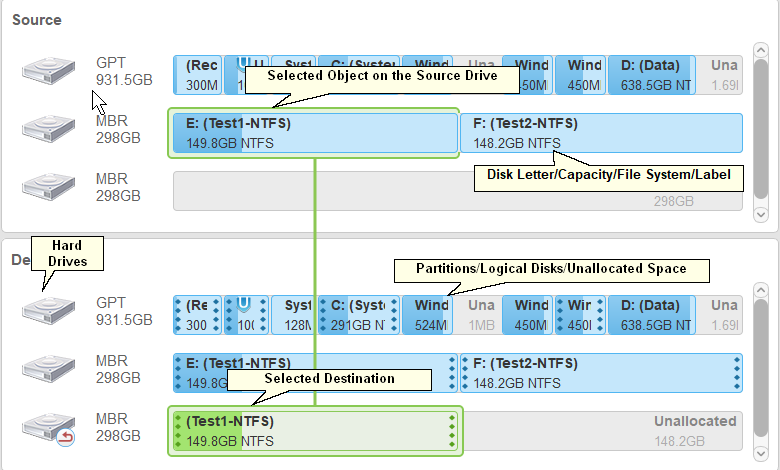
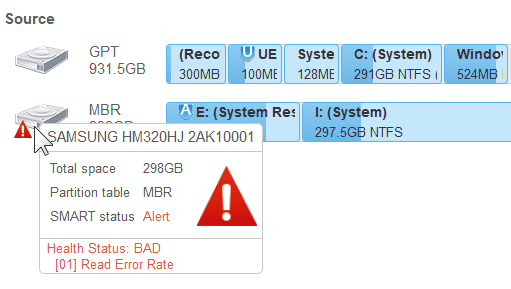
S.M.A.R.T. warning for a hard drive
|
If a hard drive has S.M.A.R.T. warnings, a color mark will appear on its left-top corner. Drugging the cursor over the drive will show a tooltip explaining that warning.
Warnings will also appear in confirming e-mails for scheduled actions . * ===================[S.M.A.R.T.]=================== ! SAMSUNG HM320HJ 2AK10001(298GB #2): Health Status: BAD [01] Read Error Rate ! ===================[S.M.A.R.T.]=================== S.M.A.R.T. (Self-Monitoring, Analysis and Reporting Technology) is a technology widely-used in hard drives and solid-state devices that monitors their reliability conditions to predict possible hardware failures. |
If you try to copy data to or from a system, or other disk locked by the system or other application, the Disk not locked message will appear.
To continue copying you may:
|
• If you copy data to or from your system disk , select Restart computer (recommended) to continue restoring the data in the R-Drive Image startup mode. Read carefully the Disk to Disk Copy Using the Startup Disks topic before you proceed. • If you copy data to a disk locked by other low-level disk software (including Windows internal services) , stop this software and select Retry to lock the disk once again. • You may also try to unlock the disk by selecting Force Windows to unlock the disk (not recommended) . If Windows fails to unlock the disk, the Disk not locked message will appear again. You will need to stop the software locking the disk manually or select Restart computer (recommended) to continue copying the data in the R-Drive Image startup mode. Note: Use this option cautiously, because it may cause unpredictable results including system crash and data loss. |
You may select all objects on a hard drive by clicking the hard drive icon .. It will show the marked hard drive .
| 3 | Specify copy parameters on the Restore/Copy Parameters panel and click the Next button |
Restore parameters
|
You may change create/copy/modify parameters on the Create partition , Copy partition , or Modify partition panel. Click the Create / Copy Options / Modify button, respectively.
|
|
Partition ing scheme |
The type of partition ing scheme . See Support for Various Disk Partition Schemes and File Systems for the list of supported partition types. |
|
Partition type |
Primary (Active)/ Primary/Logical You may specify the type of the partition to be restored. Do not change this setting unless you have serious reasons to do so. |
|
File system |
You may select the file system for the partition to be restored. |
|
Allocation unit size |
It is the size of a disk block, that is, the minimum allocatable disk space. (only on the Create partition panel.) |
|
Volume label |
Label of this volume. You can change it. |
|
Drive letter |
Select the letter that will be assigned to the partition. You may select "Do not connect" if you do not want to connect this partition to your system. Or "Do not modify" it you do not want to change the drive letter. |
|
Partition size |
Minimum/maximum size of the partition to be restored. |
|
Free space before |
You may specify the size of free space that will be left on the hard drive before the beginning of the partition. |
|
Partition size |
You may specify the size of the partition to be restored. Should be between the minimum and maximum partition size. |
|
Free space after |
You may specify the size of free space that will be left on the hard drive after the end of the partition. |
|
|
You may visually adjust the location and size of the object to be restored. All other restore options will be adjusted accordingly. Also, when you adjust one or several restore options directly, these changes will be shown visually. Green marks available space. See Support for Various Disk Partition Schemes and File Systems for the list of supported file systems. |

|
The Restore/Copy Parameters panel will be different with different sets of options:
See Support for Various Disk Partition Schemes and File Systems for details. When you copy a system disk, a disk signature collision may occur. In this case, the Copy options panel will inform you about this. You may specify the way to resolve this collision on the Disk Signature Collision panel.
|
||||||||||||||||||||
| 4 | Verify that the information on the Processing panel is correct and click the Start button |
You may also create a script for this action. Click the Script to Clipboard button and paste the script to any text-processing utility
| > | R -Drive Image will start copying the data from the source to the selected destination place. |
When the data is copied, the Object copied successfully message will appear.
If some other program (like a file manager) is accessing the partition on which the data is to be restored, the Cannot lock the disk message will appear. Close this program or make it stop accessing the partition.
If you copy an entire hard drive to another hard drive, two absolutely identical hard drive will appear in your system. That will confuse it and may cause unpredictable results. To prevent that, a Disk copied successfully message will appear. You may turn your system off to disconnect one of the disks, or restart it to disable one of the disk in the BIOS of your system. Under Windows 95/98/Millennium, the target disk will not appear until system restart even if you decide to click the Cancel button.
Bad Sectors
|
When R-Drive Image encounters a bad sector, the IO Error message will appear. You may either cancel the current action or fill the bad sectors with zeros. IO Error Options
|
The Disk Actions chapter explains basic disk actions.
The Startup Version chapter explains how to perform disk actions using the R-Drive Image Startup Version .
The Technical Information chapter gives technical information on Supported CD and DVD Recorders and List of Hardware Devices Supported in the Startup Mode and another useful technical information.
Follow this link to obtain R-Drive Image Contact Information and Technical Support
- Data Recovery Guide
- Why R-Studio?
- R-Studio for Forensic and Data Recovery Business
- R-STUDIO Review on TopTenReviews
- File Recovery Specifics for SSD devices
- How to recover data from NVMe devices
- Predicting Success of Common Data Recovery Cases
- Recovery of Overwritten Data
- Emergency File Recovery Using R-Studio Emergency
- RAID Recovery Presentation
- R-Studio: Data recovery from a non-functional computer
- File Recovery from a Computer that Won't Boot
- Clone Disks Before File Recovery
- HD Video Recovery from SD cards
- File Recovery from an Unbootable Mac Computer
- The best way to recover files from a Mac system disk
- Data Recovery from an Encrypted Linux Disk after a System Crash
- Data Recovery from Apple Disk Images (.DMG files)
- File Recovery after Re-installing Windows
- R-Studio: Data Recovery over Network
- How To Use R-Studio Corporate Package
- Data Recovery from a Re-Formatted NTFS Disk
- Data Recovery from an ReFS disk
- Data Recovery from a Re-Formatted exFAT/FAT Disk
- Data Recovery from an Erased HFS Disk
- Data Recovery from an Erased APFS Disk
- Data Recovery from a Re-Formatted Ext2/3/4FS Disk
- Data Recovery from an XFS Disk
- Data Recovery from a Simple NAS
- How to connect virtual RAID and LVM/LDM volumes to the operating system
- Specifics of File Recovery After a Quick Format
- Data Recovery After Partition Manager Crash
- File Recovery vs. File Repair
- Data Recovery from Virtual Machines
- How to Connect Disks to a Computer
- Emergency Data Recovery over Network
- Data Recovery over the Internet
- Creating a Custom Known File Type for R-Studio
- Finding RAID parameters
- Recovering Partitions on a Damaged Disk
- NAT and Firewall Traversal for Remote Data Recovery
- Data Recovery from an External Disk with a Damaged File System
- File Recovery Basics
- Default Parameters of Software Stripe Sets (RAID 0) in Mac OS X
- Data Recovery from Virtual Hard Disk (VHD/VHDX) Files
- Data Recovery from Various File Container Formats and Encrypted Disks
- Automatic RAID Parameter Detection
- IntelligentScan Data Recovery Technology
- Multi-pass imaging in R-Studio
- Runtime Imaging in R-Studio
- Linear Imaging vs Runtime Imaging vs Multi-Pass Imaging
- USB Stabilizer Tech for unstable USB devices
- Joint work of R-Studio and PC-3000 UDMA hardware
- Joint work of R-Studio and HDDSuperClone
- R-Studio T80+ - A Professional Data Recovery and Forensic Solution for Small Business and Individuals Just for 1 USD/day
- Backup Articles
- R-Drive Image Standalone and Corporate license transferring
- Backup with Confidence
- R-Drive Image as a free powerful partition manager
- Computer Recovery and System Restore
- Disk Cloning and Mass System Deployment
- Accessing Individual Files or Folders on a Backed Up Disk Image
- Creating a Data Consistent, Space Efficient Data Backup Plan for a Small Business Server
- How to Move the Already Installed Windows from an Old HDD to a New SSD Device and Create a Hybrid Data Storage System
- How to Move an Installed Windows to a Larger Disk
- How to Move a BitLocker-Encrypted System Disk to a New Storage Device
- How to backup and restore disks on Linux and Mac computers using R-Drive Image
- Undelete Articles
- Get Deleted Files Back
- Free Recovery from SD and Memory cards
- R-Undelete: Video Recovery
- Recovery from an External Device with a Damaged File System
- File recovery from a non-functional computer
- Free File Recovery from an Android Phone Memory Card
- Free Photo and Video File Recovery Tutorial
- Easy file recovery in three steps